
Sign Language and Generalization. DexForce at ICRA 2026
ICRA (IEEE International Conference on Robotics and Automation) is a premier international conference in the field of robotics and automation. Hosted by the IEEE Robotics and Automation Society, it attracts submissions each year from top academic institutions and industry researchers around the world. As a bellwether of the robotics field, ICRA 2026 will continue to drive innovation in frontier directions such as artificial intelligence, bio-inspired robotics and human-robot interaction, and to accelerate the translation of academic results into practical applications, marking a milestone for the development of robotics worldwide.
At this edition of ICRA 2026 , two significant papers co-presented by the DexForce Technology team together with leading research teams including Imperial College London and CUHK-Shenzhen were successfully accepted with high scores.
01 SignBot: Learning Human-to-Humanoid Sign Language Interaction
Authors: Guanren Qiao, Sixu Lin, Ronglai Zuo, Zhizheng Wu, Kui Jia, Guiliang Liu
Affiliations: School of Data Science, CUHK-Shenzhen; Imperial College London; DexForce Technology
Core contribution: Proposes the first end-to-end sign language interaction framework for the Deaf and hard-of-hearing community, enables natural sign language dialogue between robots and humans, and supports accurate transfer across multiple robot platforms.
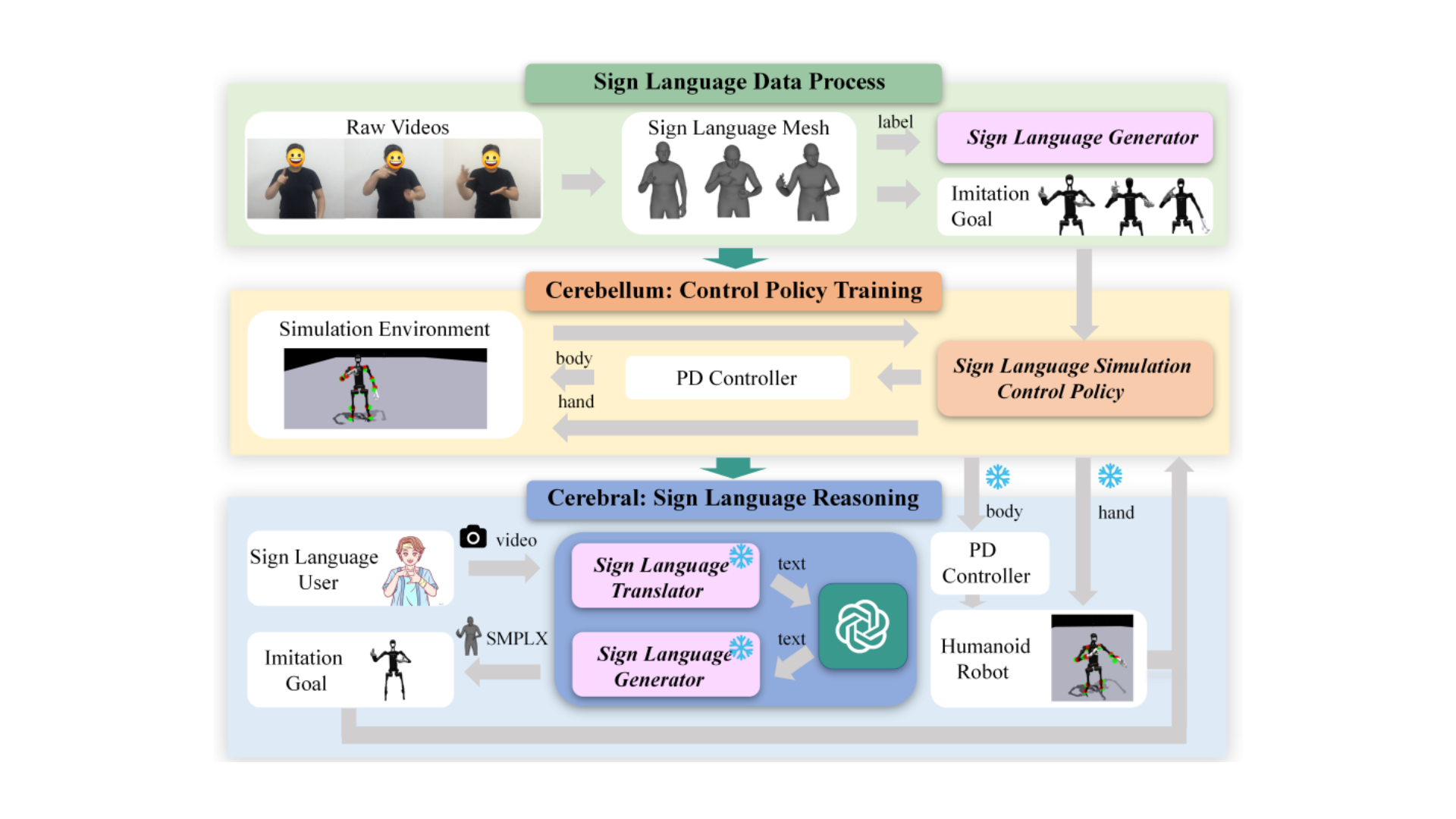
Methodological innovation: Adopts a bio-inspired modular design, maps human motion onto robots through motion retargeting, and combines decoupled policy training with a generative interaction pipeline to achieve closed-loop control.
Significance: Provides a practical communication tool for underserved groups, advances the deployment of embodied AI in service robotics, and opens a new direction for human-robot interaction.
Abstract: Sign language is a natural, visual form of language that conveys meaning through motion and facial expression, and serves as a critical communication tool for people who are Deaf or hard of hearing (DHH). Yet people fluent in sign language remain few, and technological breakthroughs are urgently needed to bridge this communication gap. Building on recent progress in humanoid robotics, we propose SignBot, a novel framework for sign language interaction between humans and humanoids. SignBot integrates a cerebellum-inspired motion control module and a brain-oriented comprehension and interaction module, comprising: 1) motion retargeting, which converts human sign language datasets into robot-compatible kinematic formats; 2) motion control, which develops robust humanoid control policies through learning paradigms to track sign language gestures; and 3) generative interaction, which combines a sign language translator, responder and generator to enable natural, efficient communication between robots and humans. Simulation and real-world experiments show that SignBot effectively facilitates human-robot interaction and accurately performs sign language motions across multiple robots and datasets. SignBot represents a significant advance in automated sign language interaction on humanoid robot platforms, and offers a promising solution for improving communication accessibility for the DHH community.
Paper link: https://qiaoguanren.github.io/SignBot-demo/
02 ImaginationPolicy: Towards Generalizable, Precise and Reliable End-to-End Policy for Robotic Manipulation
Authors: Dekun Lu and the DexForce Technology Algorithm Team
Affiliations: DexForce Technology; South China University of Technology
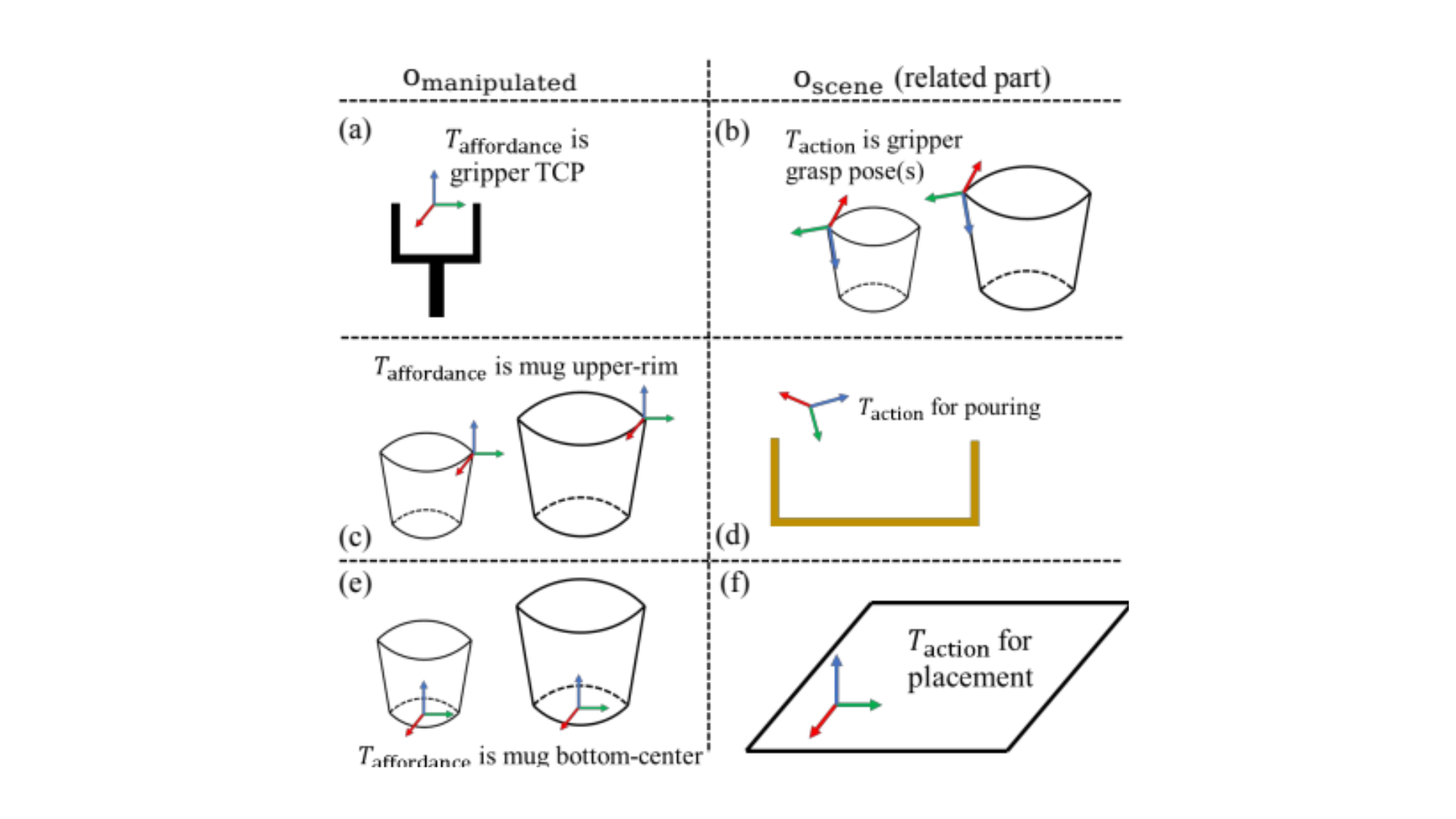
Core contribution: Proposes the Chains of Moving Oriented Keypoints (CoMOK) representation, which unifies the action representation across multiple manipulation tasks and delivers sub-centimeter precision with cross-object generalization.
Methodological innovation: Models manipulation behaviors with task-oriented keypoint chains, generates multimodal action sequences with diffusion models, and combines them with hierarchical networks for end-to-end decision-making and motion planning.
Significance: Significantly lowers the development barrier for complex robotic manipulation tasks, provides an out-of-the-box solution for industrial automation, and promotes the integration of robot learning with large-scale models.
Abstract: End-to-end robotic manipulation policies hold remarkable potential, enabling embodied agents to understand and interact with the world. Compared with traditional modular pipelines, end-to-end learning avoids information loss and feature misalignment between modules. Despite the progress of existing end-to-end approaches built on vision-language-action (VLA) models, their reliability and precision remain insufficient for large-scale real-world deployment. This paper proposes a novel Chains of Moving Oriented Keypoints (CoMOK) representation as the action representation for robotic manipulation. The representation can be trained end to end and generalizes standard end-effector pose actions. Oriented keypoints support natural generalization across objects of different shapes and sizes and achieve sub-centimeter precision, while readily handling multi-stage tasks, multimodal behaviors and deformable objects. Extensive simulation and real-robot experiments validate the effectiveness of the method.
Paper link: https://arxiv.org/pdf/2509.20841
The two papers published by the DexForce team at ICRA 2026 demonstrate its academic leadership in two frontier directions: human-to-humanoid sign language interaction and end-to-end robotic manipulation. SignBot breaks down communication barriers for the Deaf and hard-of-hearing community through bio-inspired design, while ImaginationPolicy upgrades the generalization capability of robots with a general action representation, together reflecting the depth of innovation and the real-world deployment potential of DexForce in embodied AI, and laying a solid cornerstone for the societal application of robotics.