
A World Model That Truly Connects to the Physical World
To truly solve the long-term challenge of embodied AI in the real world, letting a model merely “understand” pixels is not enough. The DexForce Technology team has consistently held that to truly solve this pain point, a system must build a deep connection with the 3D physics of the real world. That is, the model must understand the structure, the physical laws, and the dynamics of the world, and make reliable decisions and executions within it.
Over the past few years, world model technologies built on video generation have made remarkable progress. For robots, however, these capabilities are only a starting point — a system that can only generate or predict two-dimensional visual sequences remains far from being able to operate reliably in the physical world.
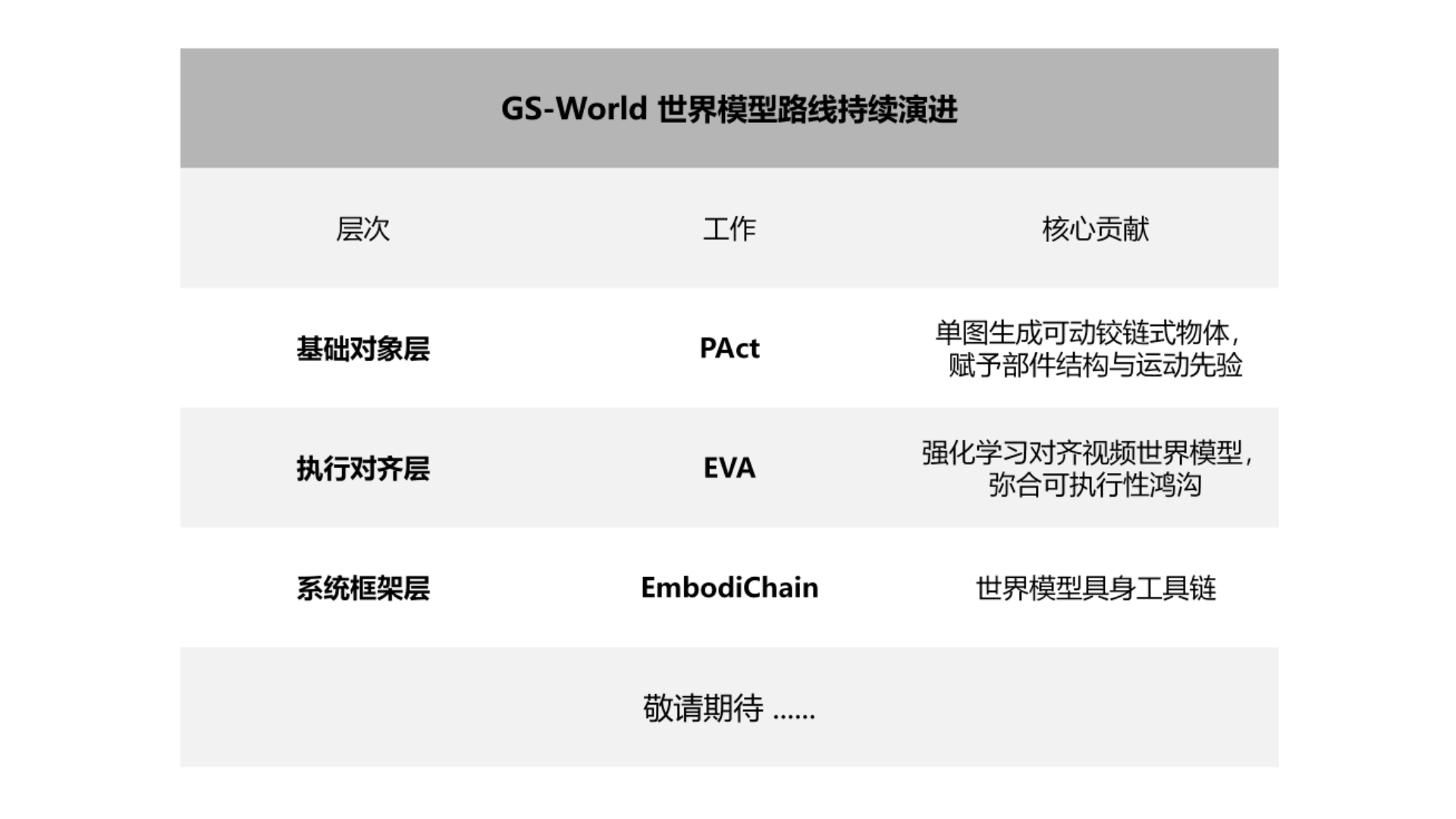
Along this core idea, our team has kept evolving a more fundamental, longer-horizon technical thread: building a complete world model for real interactive scenarios World Models of Generative Simulation (GS-World), that is, a physically plausible, interactive, and 3D-native world model. Along this path, driven by the GS-World philosophy and the open-source engine EmbodiChain, we have recently released two of our latest and most representative works:
-PAct: solves the problem of “how to efficiently generate the basic units of the physical world”, rapidly generating structured, movable, articulated 3D objects from a single image.
-EVA: solves the problem of “how a world model can truly guide a robot”, using reinforcement learning to actively pull the video generation distribution back onto the physically executable manifold of the robot.
These recent research efforts are not isolated nodes; they all point to the same goal: making world models not just "able to imagine the future", but "able to empower robots to actually deliver in the real 3D physical world".
In what follows, we introduce the core ideas and experimental progress of these two latest works, and finally return to the overall framework to explain how together they lay the technical foundation of our path toward embodied world modeling.
01 Foundation Object Layer: PAct — Faster, More Accurate, and More Controllable Generation of Complex (Articulated) Objects
1.1 Why start with "movable objects"?
In any embodied world model, articulated objects are the most essential and most common basic units. Cabinet doors rotate, drawers slide out, and microwave doors open and close — objects with movable structures are ubiquitous in real-world manipulation scenarios.
Only by first modeling these objects as decomposable, movable, and interactive structured entities can higher-level graph modeling, dynamics reasoning, and interaction prediction rest on a reliable foundation. Generating a "static 3D model" is far from enough — the system must also recover key information such as part structure, joint types, rotation axes, and ranges of motion.
Yet the construction of such high-quality movable 3D assets has always been hard to scale and automate.
-One family of methods relies on per-instance optimization or distillation: the results can be fairly accurate, but often take tens of minutes or even hours per object;
-Another family relies on template libraries or part retrieval: faster, but often unable to truly match the specific structure and appearance in the input image — the output "looks like a cabinet", yet is not necessarily "this cabinet".
1.2 The core idea of PAct: part-centered joint generation
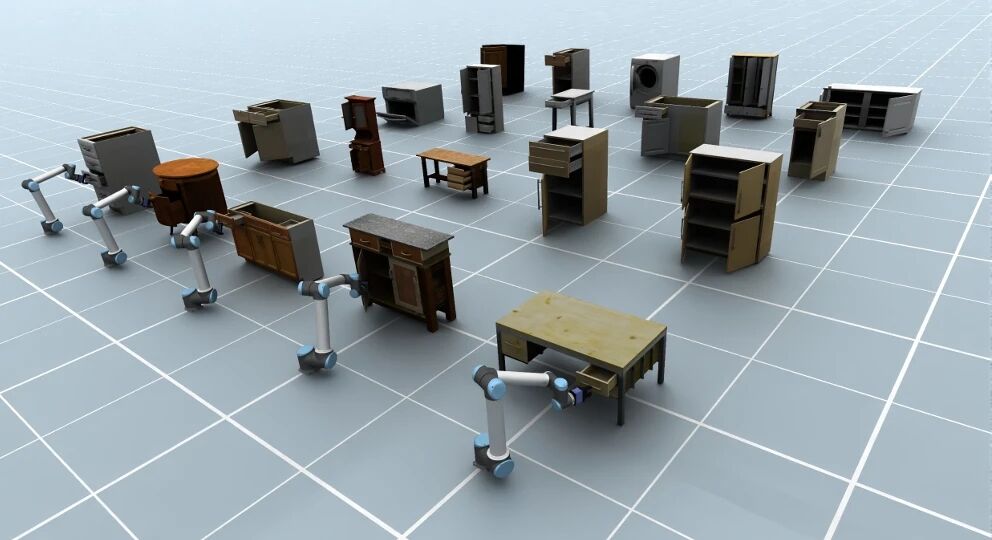
Paper title: PAct: Part-Decomposed Single-View Articulated Object Generation
Paper link: https://arxiv.org/pdf/2602.14965
Code link: https://github.com/PAct-project/PAct (open-sourced)
The core idea of PAct can be summed up in one sentence: do not treat an articulated object as a whole to be "guessed"; treat it as a set of movable parts with semantic and motion relationships, and generate it in a part-centered way.
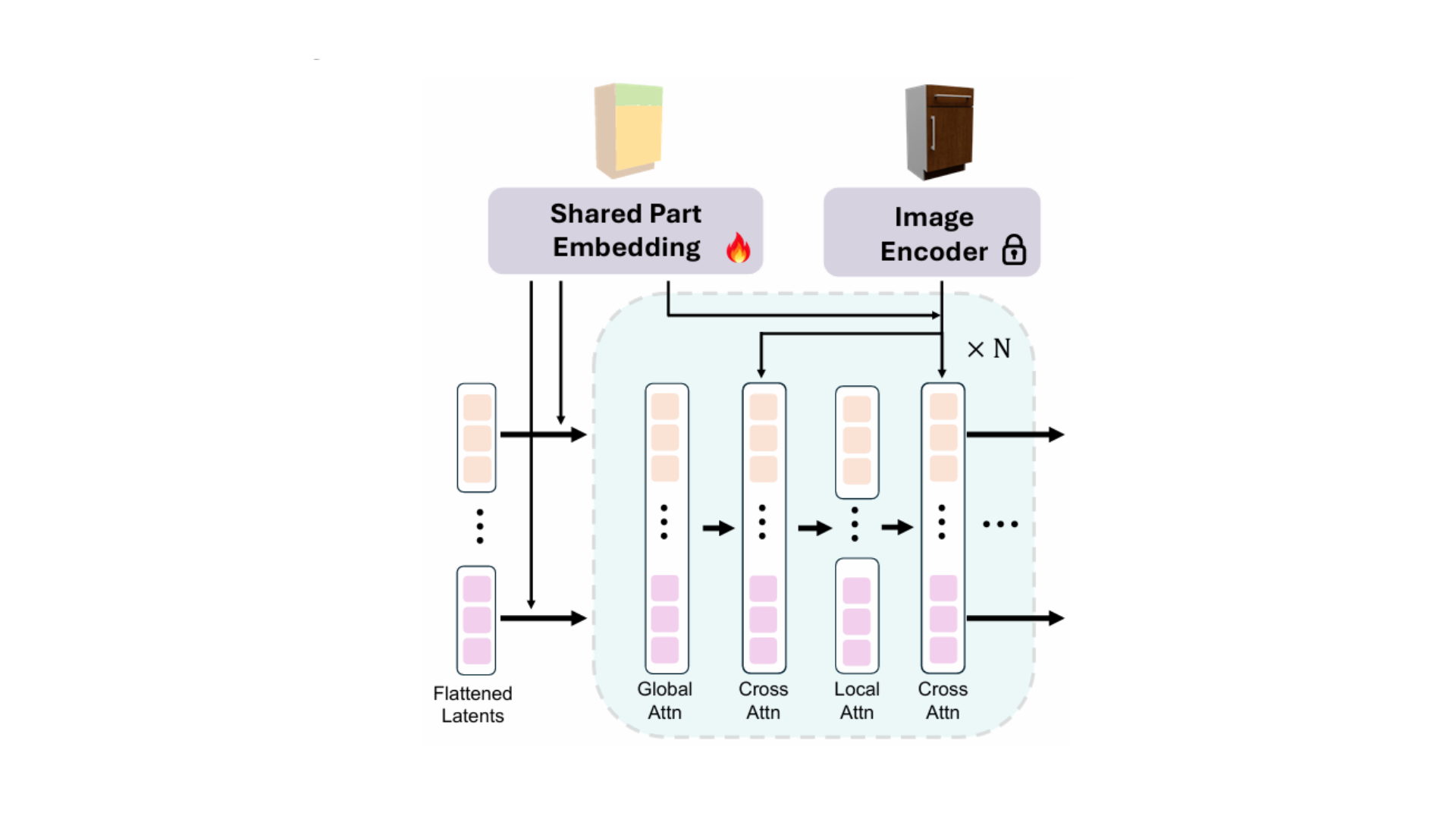
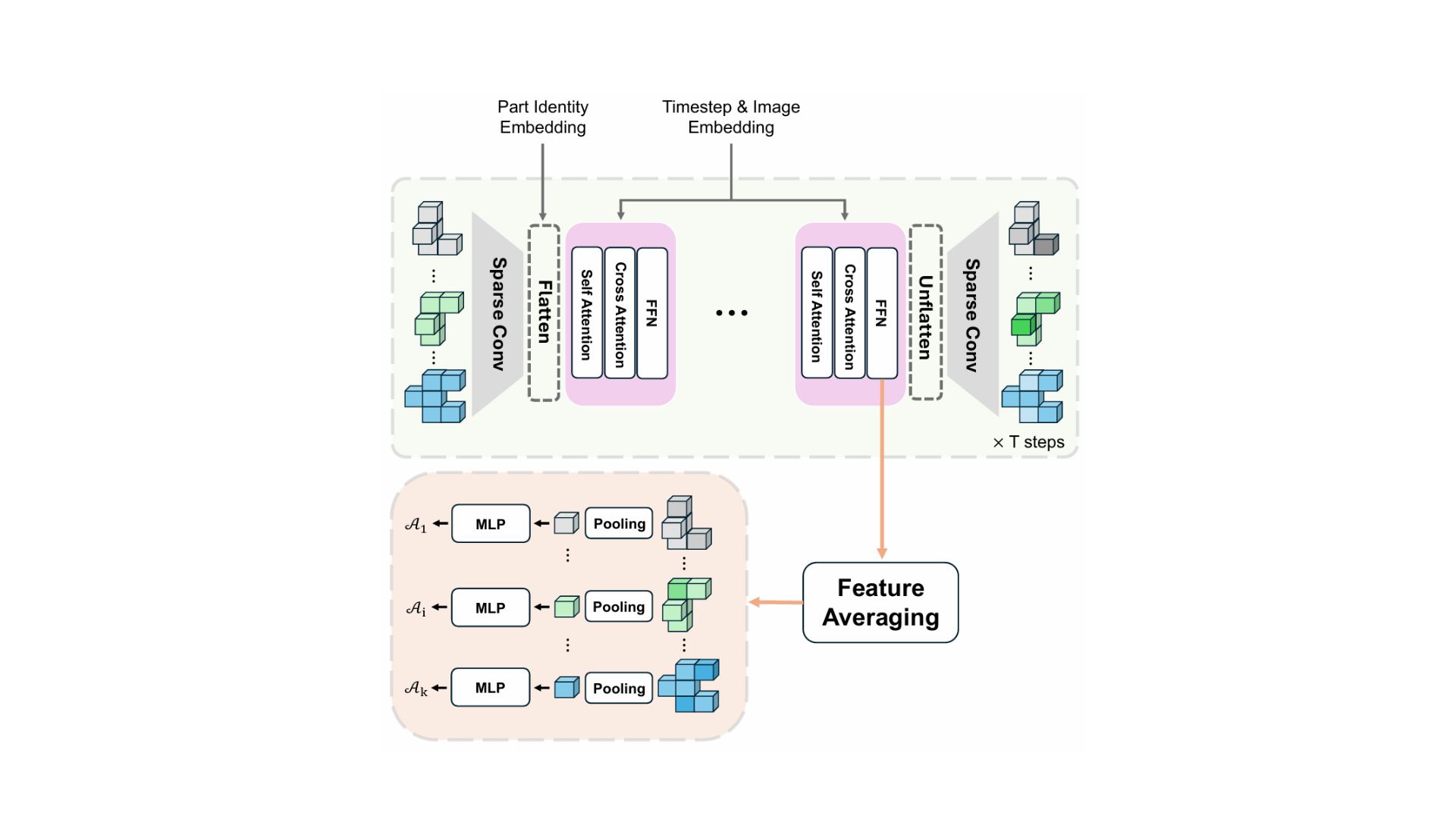
In terms of representation, PAct models an articulated object as a set of movable parts, each represented by a latent token, with explicit part-identity information added to distinguish the parts. Conditioned on a single input image, the model must generate not only the 3D geometry and texture of the object, but also the motion structure at the same time.
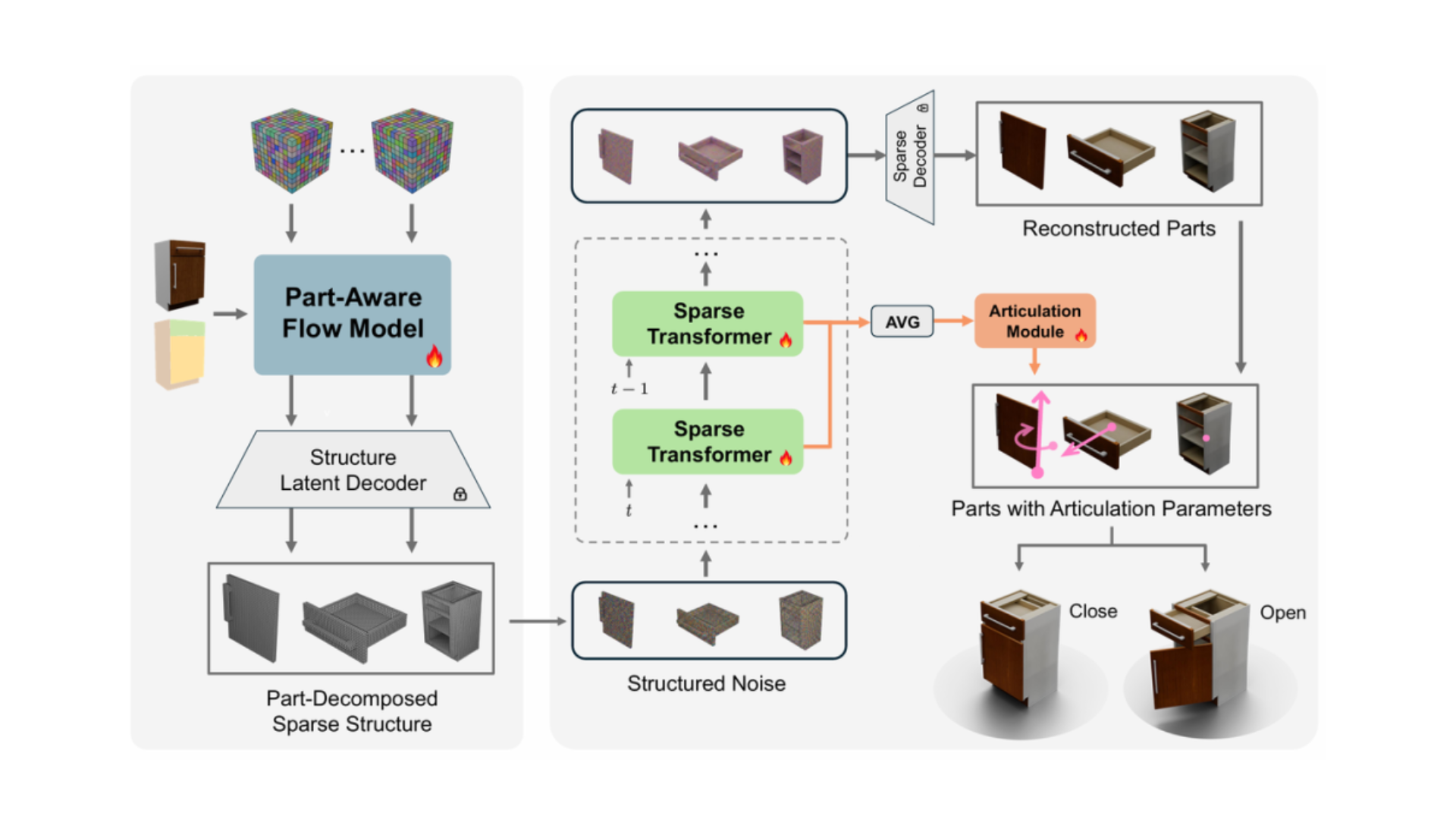
PAct achieves this goal with a two-stage pipeline:
>Stage 1: Predicting the sparse structure of the decomposed parts
From a single image, the model first uses Part-aware Flow Model to predict the coarse structure of all constituent parts — first answering "which parts make up this object, and how they form the whole". Through explicit part-aware conditioning, structure generation is no longer a black-box prediction over the whole, but carries clear part-level priors.
>Stage 2: Generating refined part representations and regressing motion information
Given the part structure, PAct then refines the coarse structure into high-fidelity 3D part geometry and appearance through a sparse Transformer denoising process; at the same time, the features obtained from multi-step denoising are aggregated to generate the motion information of each part (motion axes, joint types, ranges of motion, and so on). In other words, PAct does not "first generate a 3D object and then figure out how to give it a skeleton"; it places part structure, geometry and appearance, and motion dynamics into a unified framework for joint consideration from the very beginning.
1.3 The practical strengths of PAct: from “looking alike” to “physically credible”, together with efficient inference
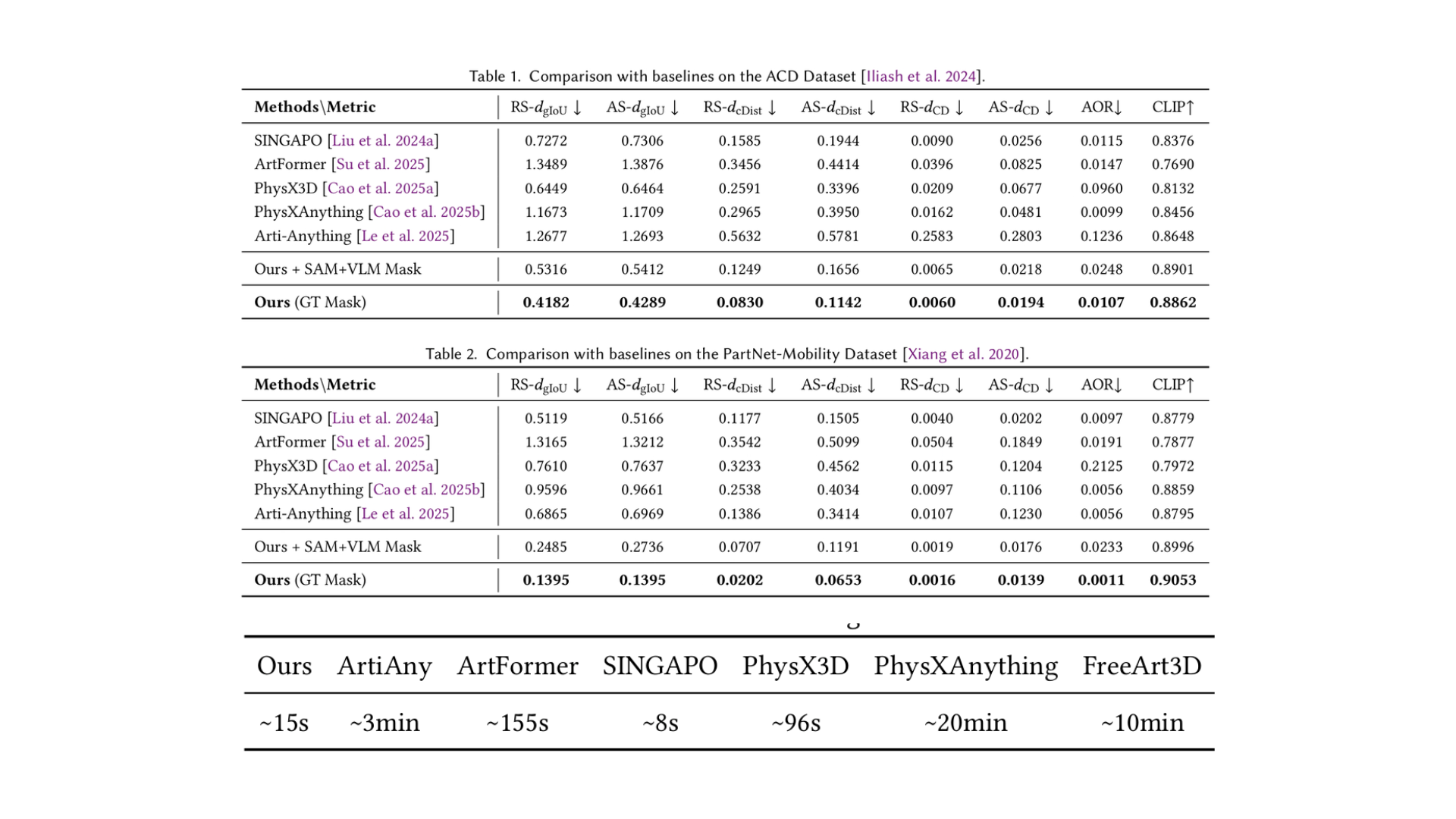
On authoritative datasets such as PartNet-Mobility, PAct not only surpasses representative existing methods (such as Articulate-Anything and PhysX-3D) in geometric error and Chamfer Distance, but more importantly recovers true part boundaries and credible joint parameters.
What excites industry even more is its efficiency and controllability:
-Extreme inference speed: per-sample inference time is compressed to roughly 15 seconds — firmly in the first tier among current approaches — making PAct well suited for large-scale simulation data synthesis
-Real-world generalization: it demonstrates strong transfer even on in-the-wild images full of lighting and material noise (such as real microwave ovens and desks).
-Mask-level controllability: from the same appearance image, users can explicitly specify through 2D masks whether the structure is “double doors” or “two doors plus two drawers”, replacing the “blind box” experience of traditional generation with far greater controllability.
>The extensibility of PAct: from motion structure to full physical properties
Worth noting is that the PAct framework is not limited to generating joint parameters and motion structures. Because it adopts a part-centric structured representation, it extends readily to physical property generation, such as mass, material, friction, stiffness, and other properties related to interaction and dynamics. In other words, PAct can answer not only "how this object moves", but also has the potential to answer "how this object would move and respond to forces in the physical world".
This makes it easy for the method to extend into our more general world model representation framework, where it becomes the foundation object layer of 3D physical world models. Objects are no longer merely static geometry or motion skeletons, but complete entities with structure, motion, and physical properties, ready to be organized into larger-scale scene graphs and dynamic world models.
02 Execution Alignment Layer: EVA — Making Video World Models Truly "Move" on Robots via Reinforcement Learning
2.1 The key bottleneck of video world models: the executability gap
If PAct creates interactive assets for the physical world, the EVA (Executable Video Alignment) framework is dedicated to helping the “brain” of the robot truly master the laws of interaction in the physical world.
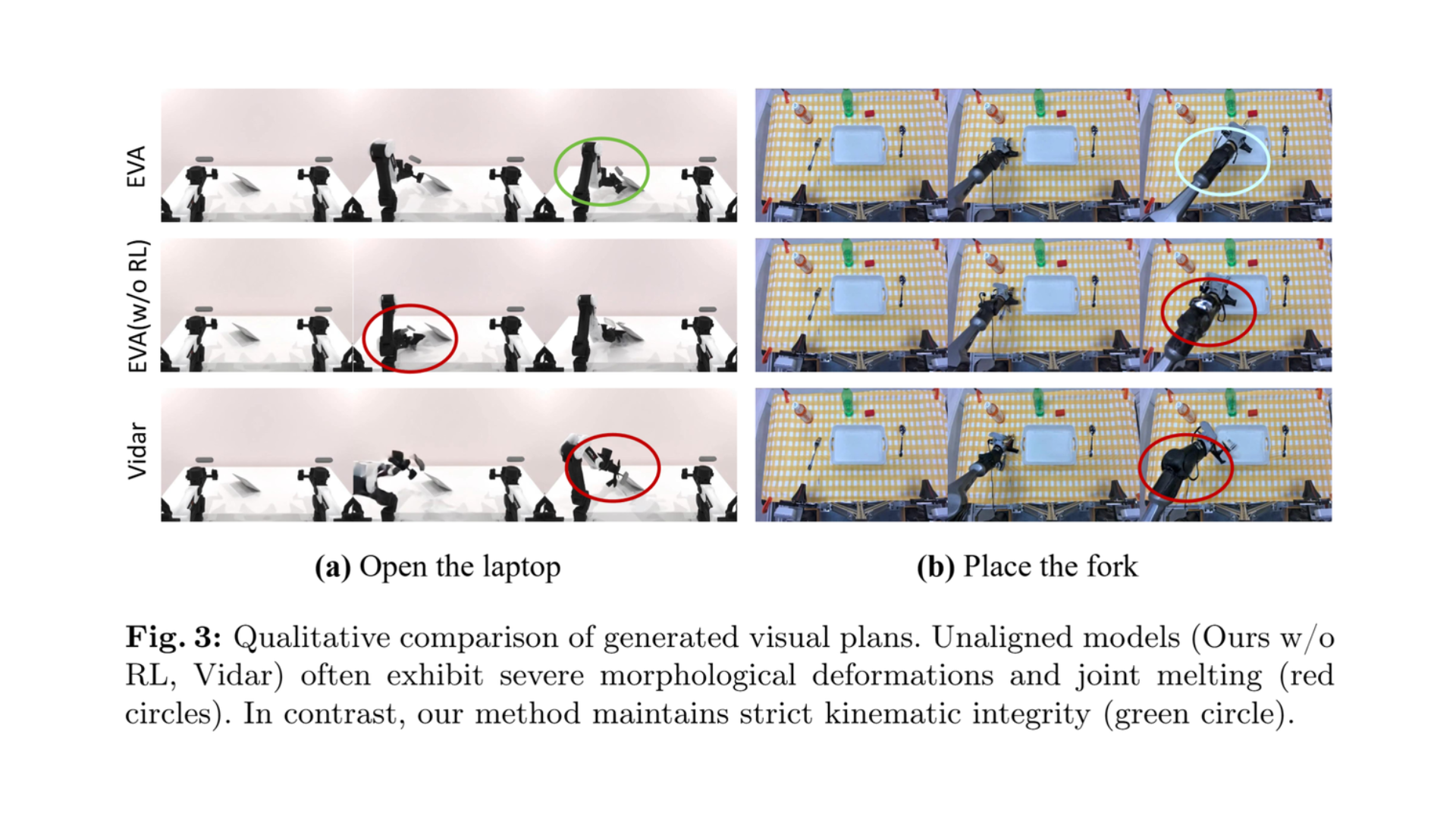
Many of today’s world models are strikingly realistic when “imagining” future video, yet because they do not truly understand the body structure, joint constraints, and kinematics of the robot, the generated trajectories often exhibit local deformations of the manipulator, joint interpenetration, and temporal jumps. These minute flaws, barely visible to the eye, can decode through inverse dynamics into catastrophic execution errors. This is the troublesome “Executability Gap” of this line of work.
2.2 The EVA framework: reinforcement learning alignment driven by inverse dynamics rewards
Paper title: EVA: Aligning Video World Models with Executable Robot Actions via Inverse Dynamics Rewards
Paper link: https://arxiv.org/abs/2603.17808
Project page: https://eva-project-page.github.io/
Code link: https://github.com/RobbinW/EVA
The core idea of EVA is direct and forceful: since what the robot ultimately needs is an executable action sequence, the training objective of a video generation model should not be decided by visual quality alone, but should further introduce constraints from the action space.
>How it works
EVA first trains an inverse dynamics model (IDM) that can recover robot actions from local temporal changes in video; it then extends this IDM to serve as a reward model, used to assess whether the action sequence corresponding to the generated video is smooth, reasonable, and consistent with the physical constraints of the robot.
Training proceeds in two stages:
>Supervised fine-tuning stage: the model answers — does this video look real? Does it match the task semantics?
>Reinforcement learning alignment stage: the model further answers — if this video were translated into actions, could the robot actually execute them? Is the corresponding action trajectory smooth? Does it violate body constraints such as velocity and acceleration? Would it produce abrupt jumps or unstable control?
In reward design, the research team explicitly introduces action velocity variation, acceleration smoothness, and a higher-order jerk regularization term, while penalizing anomalous actions that exceed the physical limits of the robot.
In essence, EVA is not simply "patching flaws in the video" — it is actively pulling the video generation distribution back onto the manifold of robot-feasible motion.
2.3 A demanding examination: an undisputed leap forward
>Visual planning quality
After RL alignment, the EVA model improved "kinematic plausibility" by 20.9% over the unaligned baseline model, with Perfect Execution reaching 83.8%. This shows that what EVA optimizes is not just "whether the visuals look natural": it reduces structural artifacts — manipulator deformations, joint ambiguity, and temporal jumps — that matter greatly for execution.
>Simulation task success rate (RoboTwin 2.0)
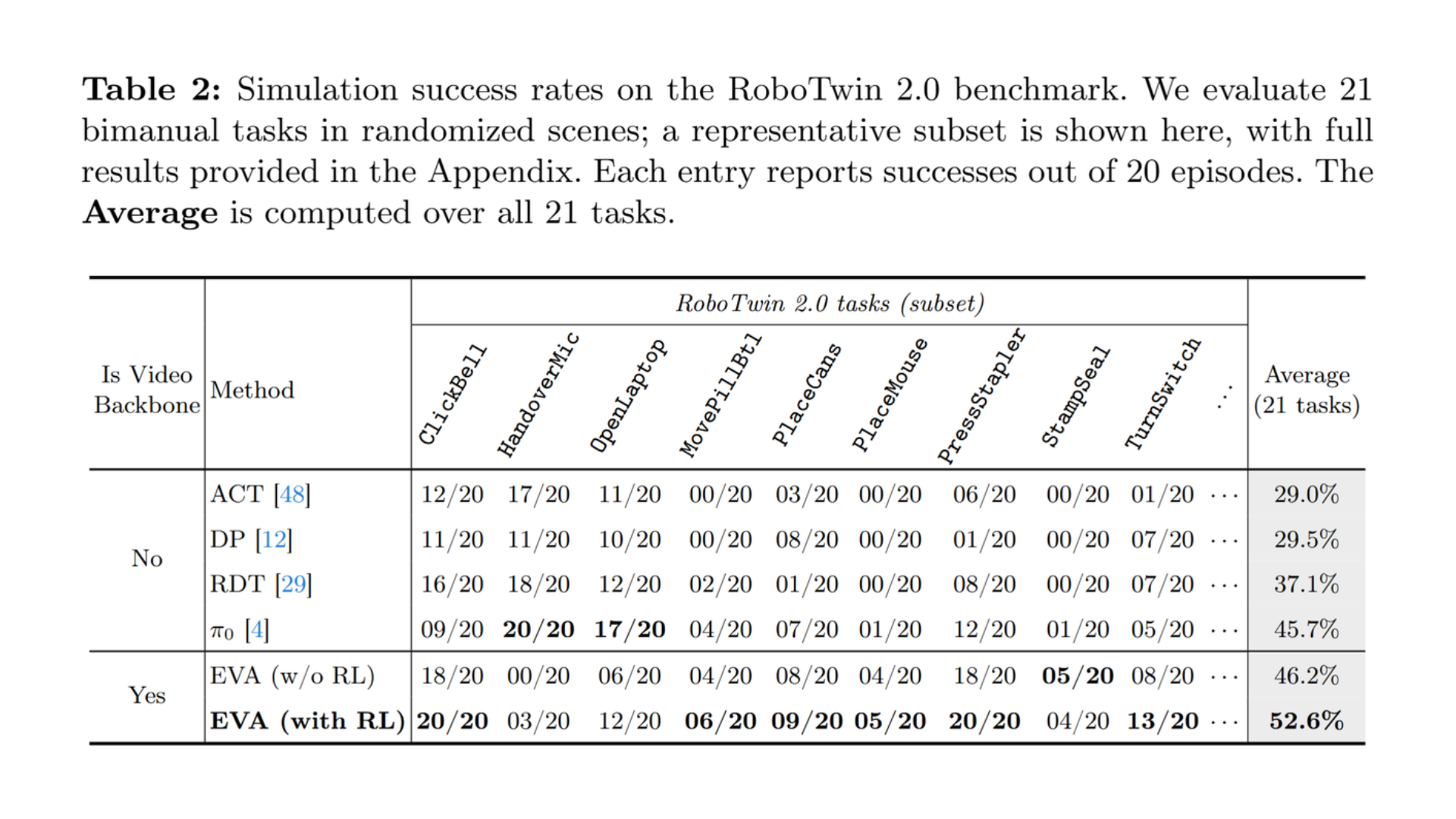
The research team chose RoboTwin 2.0 as the core evaluation benchmark. RoboTwin was chosen because it targets bimanual manipulation tasks with rich task types and strong scene randomization, and has gradually become an important public benchmark for examining the generalization and real execution potential of VLA methods and embodied world models — results on this platform carry strong persuasive weight.
In a systematic evaluation across 21 bimanual tasks, the evaluation did not merely compare whether the generated video "looks good or not": the generated videos were handed to the IDM to decode action sequences, then actually sent into the control system for execution with success rates tallied — examining "whether the future generated by a video world model can truly be carried out by a robot".
The results show that EVA (with RL) lifted the average success rate to 52.6%, not only clearly surpassing the unaligned version but also outperforming a range of representative VLA methods and robot foundation model baselines overall. Performance on representative tasks is as follows:
>Real robot deployment
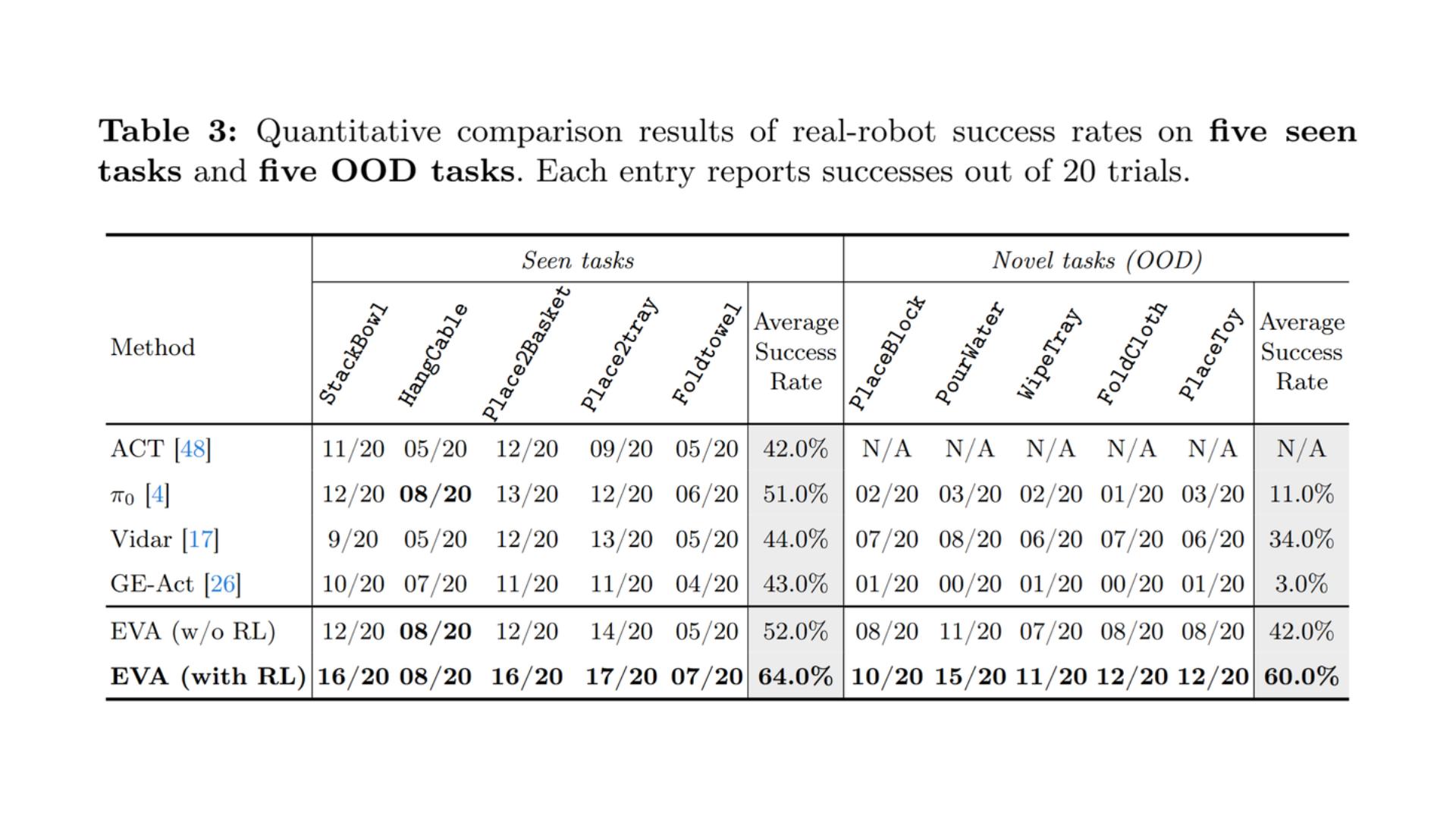
The research team further conducted deployment tests on a real bimanual robot platform, and the results show that the advantage of EVA extends robustly to the real deployment stage:
-Seen tasks: EVA (with RL) reached 64.0%, clearly above representative baselines such as ACT, $\pi_0$, Vidar, and GE-Act;
-OOD tasks (5 entirely new tasks): EVA (with RL) raised the average success rate to 60.0%, demonstrating stronger adaptation to new tasks and cross-scenario generalization.
This result deserves particular attention: compared with the simulation environment, the advantage of EVA in real robot deployment is even more pronounced, and the gap widens further. It shows that the executability gap that EVA bridges has a greater impact in the real physical world than in simulation — the closer to real deployment, the higher the demands on execution plausibility, and the alignment mechanism of EVA plays its key role precisely in this dimension.
Behind these numbers lies the core judgment of EVA: for embodied world models, what ultimately determines real-world value is not just "whether a future can be generated", but "whether the generated future can be reliably executed by a robot".
03 From "Generating" to "Executing", Toward True Embodied World Modeling
These two works do not exist in isolation; they are built on two core frameworks our team proposed earlier. GS-World (World Models of Generative Simulation) is dedicated to providing embodied systems with a generative, simulable, and evolvable world model representation with accurate 3D physical properties. EmbodiChain serves as a full toolchain for embodied AI, connecting scene generation, data synthesis, model training, and real-robot deployment into a systematic integration platform for the entire technical pipeline.
When these two capabilities — structured generation of movable objects in PAct and physical alignment at the execution level in EVA — are placed further into the larger framework built by GS-World and EmbodiChain, and organized into one 3D world model that evolves, supports forward roll-out, and obeys physical laws, we come one step closer to Embodied World Modeling in the true sense.
DexForce Technology is bringing world models back, step by step, to the foundation of 3D physics. Bridging the executability gap so that embodied AI truly takes root in the physical world — this is our enduring vision and our path.